Author Archives: meridithussery

Respond instead of being Re:swiped

registerSwipe fees recently made another public appearance in the news. Retailers have petitioned the high court to reconsider its March 2014 decision, which upheld debit card swipe fees at 21 cents per transaction as reasonable. This has been a hot topic for all retailers, with NACS being a large player representing the convenience store sector in this battle. Petroleum marketers want the limit lower than 21 cents for obvious reasons. Swipe fees—credit card and debit card—are reported as the second largest operating cost for petroleum marketers, just behind the cost of labor.1

The legal battle with swipe fees has been centered on the Dodd-Frank law passed in 2010 regarding debit card fees. The overall battle with swipe fees, however, encompasses more than just debit card swipe fees. Credit card fees were about 7 cents per gallon in 2011, averaging about 2% per transaction.1 PayPal has an even higher rate starting at 2.9% plus $0.30 per transaction.2

Margins on petroleum in this industry are already small, so any percentage “swiped” by credit card processors has a big impact to petroleum marketer operations. Mastercard and Visa have been named in the current swipe fee lawsuit, but they are by no means the only card processors in the gouging game. Nearly three quarters of all transactions made at the pump are made with plastic—think about how that equates in total swipe fees.3

Intevacon is a proprietary card processor but we offer more services to the petroleum marketer than the standard credit card company. More important to your bottom line, our pricing lets the petroleum marketer keep his/her margins. Convert one of your current Mastercard or Visa customers to a local house account and automate the process through Intevacon.  We offer an online system that empowers the petroleum marketer with all of the controls needed to manage and grow his/her fleet accounts. We also provide the petroleum marketer an advantage to capture loyal fleet accounts by offering the option of online access to the cardholder. Intevacon succeeds when our customers succeed.

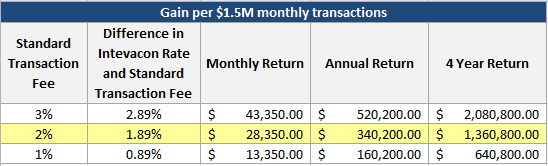
Converting cardholders who currently pay with a standard credit card or debit card to the Intevacon fleet card or prepaid card reaps huge savings every month. If a petroleum marketer converted $1.5 million of his current monthly business to the Intevacon fleet card, the savings from a standard credit card transaction fee of 2% would be approximately $340,200 a year or $1.36 million over four years. The higher the dollar volume on the Intevacon fleet card, the greater the savings from swipe fees. Supplement the fleet card with the prepaid card to get even higher returns and increase cash flow.table
Swipe fees may be a necessary evil for a certain percentage of fueling customers, but there is a large cohort of cardholders who would benefit from the advantages of carrying a fleet card. Get to know your customer base and grow your business with Intevacon.


  1. “Credit and Debit Card Fees.” NACS. Web. April 2014. http://www.nacsonline.com/Research/FactSheets/IndustryIssues/Pages/CreditCardFeesaGrowingChallengeforConvenienceStores.aspx
  2. Paypal. Web. June 2014.  https://www.paypal.com/webapps/mpp/paypal-fees
  3. “2013 Retail Fuels Report.” NACS. 2013. Web. May 2014. http://www.nacsonline.com/YourBusiness/FuelsReports/GasPrices_2013/Documents/CFR2013_FullReport.pdf


Changing Business Models: Learning to be Flexible

“One cannot alter a condition with the same mindset that created it in the first place.” -Albert Einstein

In today’s fast-moving society, businesses must adjust their bushutterstock_1561664siness models or face the risk of obsolescence. Western corporations are especially susceptible to relying on the methods that they instituted decades ago with a hope and a prayer that the economy will act in their favor. We still remember the luxury of big budgets, long timelines, and a structured approach to innovation. The 21st century, however, requires more of us. Corporations today succeed when they act fast, remain flexible, and manage frugally.

There is a lot of opportunity in our futures, and we can learn from the mistakes of corporations that have fallen away. Kodak was a pioneer in the film industry, but it failed to compete in the digital world. Barnes and Noble did not alter from their brick and mortar stores, hardly competition for the likes of Amazon. Entire industries have been trying to master the perplexity of marrying changing times with dinosaur innovation and operating methods. Big Pharma continues to increase the cost of R&D while producing fewer drugs. The auto industry required a bailout of the US government in 2008 in the amount of $62 billion, yet even with this second chance, they are still flagging against their foreign competitors. These bureaucratic, slow-moving business models are proving again and again to be unsustainable.

Hindsight is always 20/20, but there is much to be said of a proactive and flexible approach to growth moving forward. The convenience store industry has made great efforts to stay relevant in the retail space. Fresh, healthy foods are a new staple, complemented by every variety and flavor of coffee. Convenience is more of a premium than ever before, and petroleum marketers are meeting this demand with more products, cleaner facilities, and increased services. Social media is even being adopted as a way to stay connected to customers.

One area of change that directly affects petroleum marketers is that of the payment space. PCI, EMV, Chip and Card—the requirements keep changing and the fees and costs keep increasing. With credit card fees being the second highest expense to a petroleum marketer, Intevacon can offer a new approach to the payments game. There are several advantages in using Intevacon for your card processing. Our low rates are a good start when it comes to protecting your margins. Plus, our system keeps you in control and helps you manage your relationships to your cardholders. By offering your own proprietary card, you can increase the loyalty of repeat customers.

Intevacon continues to innovate and improve our business model. When we were founded, we made the decision to leave all of the legacy systems of fleet cards in the past. Intevacon is completely web-based, and we process card transactions in real time. The system is continually being improved as our R&D department functions in collaboration with our customers. In 2013, we introduced the Intevacon Prepaid Card to meet the emerging needs of our customer’s cardholders. Currently, we are developing the Intevacon Fuel Network to help link petroleum marketers across the nation and equip them to make their own business decisions.

In a world where technology changes so rapidly and information is abundant, it can be difficult to know which direction to dedicate resources. There is a Hindi word, jugaad, which translates ‘an innovative fix; an improvised solution born from ingenuity and cleverness.’While the U.S. is blessed with an advanced society, there is merit in evaluating the flexible practices being espoused by emerging markets that are forced to innovate out of necessity. Sometimes the best solutions are those that challenge our business models to shed the institutional constraints to which we have become accustomed. A flexible system with margin is much more likely to thrive in times of change.


1. Radjou, Navi, et al. Jugaad Innovation: Think Frugal, Be Flexible, Generate Breakthrough Growth. San Francisco: Jossey-Bass, 2012. Print.

Challenging Tradition: Alternative Payment Solutions

For as long as consumers have shopped, merchants have provided payment solutions. Whether it was through a barter system when money got tight or during the advent of the credit card, both buyers and sellers have gravitated to the most economical and efficient payment methods at hand. That is why this season of payment solutions is so fascinating. The trends are definitely shifting, and consumers are choosing with their wallets, literally in this case. Merchants are also seeCaptureking solutions that protect their bottom lines.

Intevacon offers a unique payment solution focused exclusively on the oil marketer—we created this system for the marketer, and our business model is built for his/her benefit. As a card processor, Intevacon provides all levels of card processing data—transaction details, quantities, taxes, product codes, etc.—without having to involve the middlemen.

Think of the traditional credit card processor. When you think of this credit card processor, you also have to think of all of the other players involved—the banks (both the cardholder and the merchant bank), the issuer of the card, the acquirer, etc. Credit card fees continue to increase as each player takes a piece of the pie. With margins for fuel counted in pennies, this cut is noticeable to a marketer. Not only does the marketer sacrifice his/her margin to processing fees, but he/she also loses the relationship to the cardholder.

We have seen traditional banks fall out of vogue more and more in time. An article in CSP News titled “Blowing Up the Bank” starts with the line “The banking system today is going to be totally blown up in the next 10 years.”1 Alternative banking and payment solutions are the way of the future. Another article corroborating this claim quotes the research firm, Packaged Facts, saying that approximately 40% of adults 18 years or older are unbanked.2 With this trend, we will continue seeing a shift away from traditional banking to “non-bank” funding accounts and reloadable prepaid cards.

Several non-traditional players have emerged, amongst them: Google, Paypal, and Amazon. We are excited for this new landscape of payment solutions, as it challenges the status quo and gives both consumers and merchants new options. When considering how you will choose to conduct business, consider your partners carefully. An article recently published in Forbes about the future of mobile payments stated, “Whoever ends up with controlling interests in this new digital ecosystem will reap billions in transaction fees, collect massive amounts of consumer data […].”3

Intevacon’s focus is to provide card processing services to our marketers so that you will be able to grow and protect your margins. Your success is our success. With Intevacon, you will always be in the center of your relationship with your customer. We are transparent and generous with our pricing model, and we offer the best customer service in the industry. Give us a call if you want to learn more about adopting a proprietary fleet card program through Intevacon. Now is the time to take back control of the transactions you are working so hard to achieve.

Contact us at 678-739-4450 or moreinfo@intevacon.com to get more information. http://www.Intevacon.com


  1. “Blowing Up the Bank.” CSP. April 2014. Web. April 2014. http://www.cspnet.com/industry-news-analysis/technology/articles/blowing-bank
  2. “General Merchandise: Prepaid & Financial Services 2014.” CSP. April 2014. Web. April 2014. http://www.cspnet.com/print/csp-magazine/article/general-merchandise-prepaid-financial-services-2014?page=0%2C0&utm_source=SilverpopMailing&utm_medium=email&utm_campaign=Daily%20News%2004-28-2014%20%281%29&utm_content=&spMailingID=45724913&spUserID=MjU0MDQ1OTk0MjkS1&spJobID=423296958&spReportId=NDIzMjk2OTU4S0
  3. “Can PayPal Beat Apple, Google, Amazon And Icahn In The Wallet Wars?” Forbes. March 2014. Web. March 2014.http://www.forbes.com/sites/stevenbertoni/2014/02/12/can-paypal-beat-apple-google-amazon-and-icahn-in-the-wallet-wars/

Building Relationships and Profiting from Repeat Business

Intevacon is all about relationships —we value the relationships that we form with our marketers, and we do everything that we can to facilitate relationships between you and your customers. The Intevacon model puts the marketer directly in the center of the card processing relationship, and this is by design. It turns out that this is also a profirepeattable approach.

A joint study by Manta and BIA/Kelsey found that 61% of small business owners report that half of their annual revenue comes from repeat customers. It also notes that repeat customers spend 67% more than a new customer. Watching this trend, small business owners are starting to invest more resources into developing relationships with their existing customer base.

Are you growing a base of repeat customers? An article by MediaPost notes that many small business owners do not utilize technology to their advantage when it comes to building loyalty and repeat business.

We know that c-stores account for 34.3% of all retail outlets as of December 2013, according to NACS. A recent NPD study found that the average consumer visits a c-store six times in a 30-day period, but that number has decreased by 1.3% in the fourth quarter of 2013. An article in Convenience Store Decisions quotes an NPD convenience store industry analyst saying, “It will remain a challenging and competitive environment in 2014 and retailers will continue to fight for dollars. C-stores can hold on to their base with the right product mix, selection, and quality, all of which are growing reasons why consumers choose the stores they do.”

The Intevacon fleet card and prepaid card are valuable tools to help you maintain repeat visits from your customers, both with consumer and commercial accounts. The proprietary fleet card and prepaid card can be accepted at all of your sites and allows your customers to receive level 3 card processing data. To help manage your accounts, you can give your cardholders access to the system to see their own data and run reports. The Intevacon system is intuitively designed and it gives you all of the controls that your customers want to manage their fleet accounts. With the time saved by using our system, you will have time to turn more new customer business into repeat customer business. Protect your margins by saving yourself from swipe fees, and increase repeat business by providing a fleet or prepaid card.

Prepaid trends more and more attractive to consumers

Intevacon inCapturetroduced the Prepaid card in the fall of 2013, and we have since established a growing base of customers selling the Prepaid card at their stores. A few of our customers even sell the Prepaid card as both a gift card and as a reloadable prepaid card, with different perks and payment requirements associated with each. There are many recent articles that have been published discussing consumer trends toward the prepaid card. We thought we would highlight a few so you can start thinking of ways to market your prepaid card.

1. An article published last month by Oil Express called “Trends: Debit card use hits new low” describes how trends are declining away from the use of debit cards and increasing in the use of Prepaid cards, especially among young adults. Bank fees and the federal debit card reform activities contribute largely to the dissatisfaction. You can find a discussion of the trends away from banking institutions in a blog here. With this continued increase in the acceptance of prepaid cards and consumer trends away from banking institutions, the timing could not be better to introduce the Intevacon Prepaid Card.

2.   An article by ATM Marketplace called “More Americans using cash to avoid data theft” noted that the recent data breaches have motivated consumers to use cash more often. Calling it the “revival in payment with cash,” the following statistics were provided:

40 percent of those aware of any data breaches said they’d started using cash for more of their purchases when shopping;

43 percent of those aged 18–34 said they’re using more cash; and

45 percent of those aged 35–44 said they’re using more cash.

The Intevacon prepaid card allows the perks of using cash while also offering the convenience of a card. Card holders can use their card at the pump and then reload it at the register. This allows you, the marketer, to increase cash flow and eliminate swipe fees.

3. In line with targeting specific age groups, a recent article by Convenience Store News titled “Millennials & C-stores: The Perfect Fit?” notes that about 75% of Millennials (those born after 1980) shop at convenience stores at least once a week, up from the 68% of total respondents. The number one reason cited by Millennials to shop at convenience stores is to buy beverages, followed secondly by the need to buy gas. Millennials also fulfill their impulses with purchases such as prepared food and health and beauty products. Read our earlier blog here about how Millennials are quickly adopting prepaid cards as a preferred method of payment. Millennials appear to be the ideal candidates to target with a prepaid card.

Let us know if you would like to find out more about our prepaid card or speak to one of our successful prepaid marketers.

All Customers, Big and Small, We Love Them All

shutterstock_287472So far the trade show season has been a wonderful opportunity for Intevacon to connect with our current marketers and create new relationships with future partners.  This is a really fun season for us, and we are excited for the opportunity to serve in this industry.  As we travel across the country and interface with so many different businesses in the process, we cannot help but notice that there is a chasm between the companies who are in business to provide a service and the companies who are in business to increase revenues. 

As everyone who flew to the last trade show can attest, the airline industry is a perfect example of an industry that has shifted perspective from focusing on its customers to focusing on its bottom line.  Traveling by plane is no longer just the price of a ticket.  There are now fees tacked onto every element of the experience—from baggage to seat selection.  Delta made a move this week to revamp its reward system starting in January 2015.  The new structure will prioritize “those sitting in the front of the plane, rather than the back-seaters,” as stated in an article published by MSN. 

The most obvious aspect of this mentality is the absence of an honorable purpose.   The agenda is no longer to serve the customer, but rather to take advantage of the customer at any opportunity.  Intevacon endeavors in every exchange to benefit the marketer.  Your success is our success.  We want to be generous in our service, our pricing, our features, and our support.  We are in business to serve you.  Intevacon provides the best product in the industry, so why not also give the ultimate level of support to our customers who use it? 

Delta’s prioritization of its high-dollar front seat customers over the “back-seaters” is an anachronism to the business model that we espouse.  We know that our smallest customers depend on us the most.  The success of their one or two sites means the success of their entire business.  We also understand that our biggest customers need special TLC to get all of their processes aligned with the Intevacon system.  We are equally invested in all of our customers, and we find that this approach fosters relationships that are both personal and gratifying.  (For more, see our blog on “What Makes Customers Happy”.)

Intevacon is built on the principles of Integrity, Value, and Confidence.  Our marketers are generous in their praise and recommendation of Intevacon, and we take pleasure in being generous in the benefits that we can offer to our marketers.     

Margins for Growth with Intevacon

iStock_000009737415SmallIntevacon continues to grow each month in the number of customers who use our system and enjoy the benefits of a proprietary fleet card and prepaid card.  It looks like the industry in general is growing as well.  A Nielson study was published recently stating that the U.S. convenience store count increased by 1.4% in 2013, adding 2,062 stores.1,2  Probably even more striking, the convenience store industry has doubled in size over the last three decades. 1,2    This is not totally surprising considering that consumers increasingly view convenience stores as more than just an opportunity to purchase fuel.  Convenience stores satisfy the demands of on-the-go consumers with their ever-expanding product lines, from fresh foods to a myriad of beverages.  In total, convenience stores comprise 34.3% of all retail outlets according to Neilson. 1,2    Of these convenience stores, 62.8% of them are managed by single-store operators. 1,2

More good news for the convenience store industry—a study from Sageworks indicates that 2013 was a strong year for fuel profits at privately held gas stations, with net profits rising almost 3% on average.3  While this is a great trend, the study also noted that privately held gas station owners experienced very little profit from each gallon of gas because the margins tend to be so thin after factoring in the original wholesale cost, taxes, and swipe fees. 3   As a contrast, convenience store retailers have a lower net profit margin on average than most retailers, with the average privately held company across all industries averaging more than 8% net profit margin. 3   This low net profit margin experienced by marketers is yet another reason why Intevacon is excited to be growing.  We are able to offer an innovative and dependable system to our marketers without the high transaction fees that are typically associated with standard credit cards.  We succeed when our marketers succeed, and that is why we have created a pricing structure that allows for higher margins and keeps the marketer in control of his/her customers.

The convenience store industry comprises an invaluable place in our society.  Intevacon is proud to offer alternative payment solutions to our marketers, both in the form of fleet cards and prepaid cards.  We enjoy growing relationships throughout the industry, and we aim to support our customers through all of their successes with a system that is both flexible and innovative to their needs.

  1. “Convenience Store Count Tops 149,000.”  NACS. January 2014. Web. January 2014. http://www.nacsonline.com/News/Daily/Pages/ND0123132.aspx#.Uuqzt_uYV6s
  2. “Convenience Store Industry Adds More Than 2,000 Stores.” CSP.net. January 2014. Web. January 2014. http://www.cspnet.com/industry-news-analysis/corporate-news/articles/convenience-store-industry-adds-more-2000-stores
  3. “Fewer Expenses, Bigger Margins in 2013.” CSP.net. January 2014. Web. January 2014. http://www.cspnet.com/fuels-news-prices-analysis/fuels-analysis/articles/fewer-expenses-bigger-margins-2013

Contact us at 678-739-4450 or moreinfo@intevacon.com to get more information.  http://www.Intevacon.com

Upcoming Trade Shows for 2014

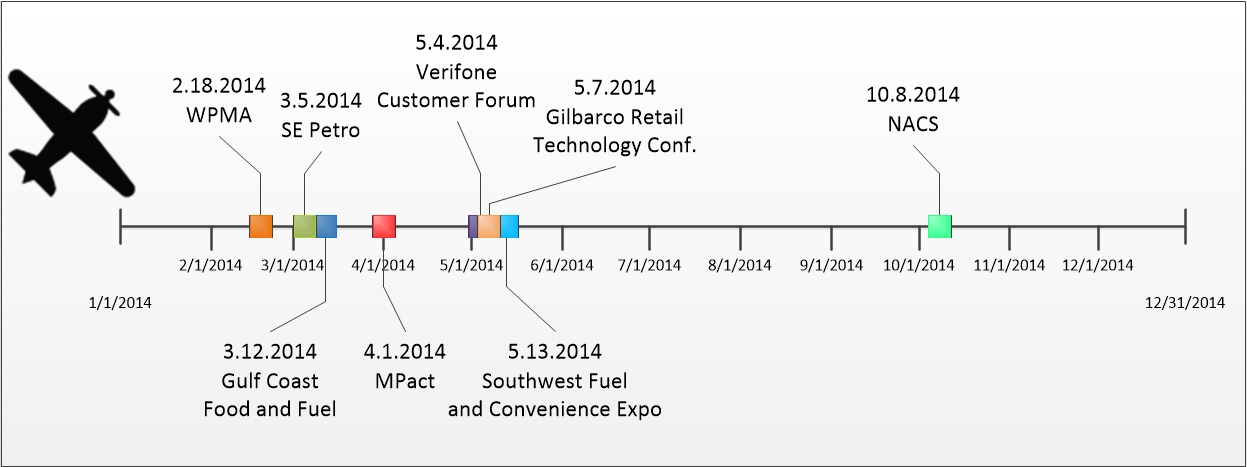
It’s getting close to our favorite time of year when we get to hit the road and meet with all of our favorite marketers.  Below is a list of upcoming trade shows that we have scheduled so far.  We’ll keep this list updated as we learn our booth number and any other information that would be helpful to connect.  Let us know if you will be attending any of these trade shows so we can keep an eye out for you!

tradeshow

You can always reach us at 678-739-4450 or moreinfo@intevacon.com to get more information.  http://www.Intevacon.com

Becoming a Convert

One of the mosshutterstock_1338696t common questions that we hear from new customers relates to the process and timing of conversion to our system.  Because of the intelligent design built into our system, conversion and training are really very simple.  Intevacon has a team of dedicated members to help our customers reach their target Go Live schedules.  We can move as fast as needed to get our customers up and running on the Intevacon system.

As a summary, below are the five basic steps for conversion onto the Intevacon System:

  1. Signed Contract
  2. Data
    • Site list and account information sent to Intevacon
    • Data imported by Intevacon
  3. Testing
    • Gateway device connected at site
    • Transaction test with POS and product codes
  4. Training
    • Intevacon system training
    • Additional system set-up (if required)
  5. Go Live

The process is direct, and Intevacon is available to assist every step of the way.  Our timelines vary from marketer to marketer, with conversion taking less than a week (whew!) to over a month depending on the marketer.  Marketers with many sites will need a technician to visit each site to set up the gateway device (small device that allows the POS to talk to our system) and conduct a swipe test at the POS.  In most cases, card account data can be automatically imported into our system, eliminating the need to manually key any account information.  For customers exporting to an accounting package, we have a transfer file that can be downloaded and sent to your accounting representative for testing.

Once customers are connected to our system, we provide remote training, and we are always available for additional questions about using the system.  We repeatedly hear about how easy it is to use our system, and the online log-in allows customers to have access from any computer to see real-time transactions.  Intevacon’s system was built for our marketers, and we continually innovate and improve to meet the needs of our customers.  Now that you know how easy it is to convert, are you ready to set up your Go Live date?


The Connection Economy

There is no doubt iStock_000000050552_L3that business models have shifted in the last few years.  Consumer expectations are changing every day.  Generational theory addresses the mindset shift of each new generation: Silent, Boomer, Gen-Xer, and Millennial.  Retailers are constantly attempting to understand how to cater to generations of the past and the future.  Employers are changing their strategies on hiring and retention.  Education systems are attempting new approaches to learning.  But there is more to the current shift in society than can be attributed to the changing generations.  Our economy has changed from the industrial age to the information age, and more recently the term Connection Economy has been used to describe our current state. 

I don’t know about you, but there is something almost hopeful in coining this new era as the Connection Economy.  It is hopeful because it not only comprises the advantages of a digital age, but it also marries relationship to resource.  This term was first introduced by Seth Godin in his book The Icarus DeceptionThis concept can also be found peppered throughout his blog

Excerpts from one of Seth Godin’s blogs describing the Connection Economy are listed below.  The complete blog post can be read here.

[T]he connection economy, our economy, the economy of the foreseeable future, embraces abundance. No, we don’t have an endless supply of the resources we used to trade and covet. No, we certainly don’t have a surplus of time, either. But we do have an abundance of choice, an abundance of connection, and an abundance of access to knowledge.

The connection economy continues to gain traction because connections scale, information begets more information, and influence accrues to those who create this abundance. As connections scale, these connections paradoxically make it easier for others to connect as well, because anyone with talent or passion can leverage the networks created by connection to increase her impact. The connection economy doesn’t create jobs where we get picked and then get paid; the connection economy builds opportunities for us to connect, and then demands that we pick ourselves.

Just as the phone network becomes more valuable when more phones are connected (scarcity is the enemy of value in a network), the connection economy becomes more valuable as we scale it.

Friends bring us more friends. A reputation brings us a chance to build a better reputation. Access to information encourages us to seek ever more information. The connections in our life multiply and increase in value.

In an era where relationships are rewarded with abundance and access is a privilege shared without discrimination, Intevacon is excited to participate in this new Connection Economy.  And we couldn’t be happier than to share in the abundance with our marketers.